Anna Redkina was born in the USSR and lived in Spain and London before settling in Paris, the city she long called home. Recently, she began a new chapter in Barcelona. A writer, globetrotter, polyglot, linguist, and psychologist, she has always been fascinated by people, dead or alive, and the stories they carry.
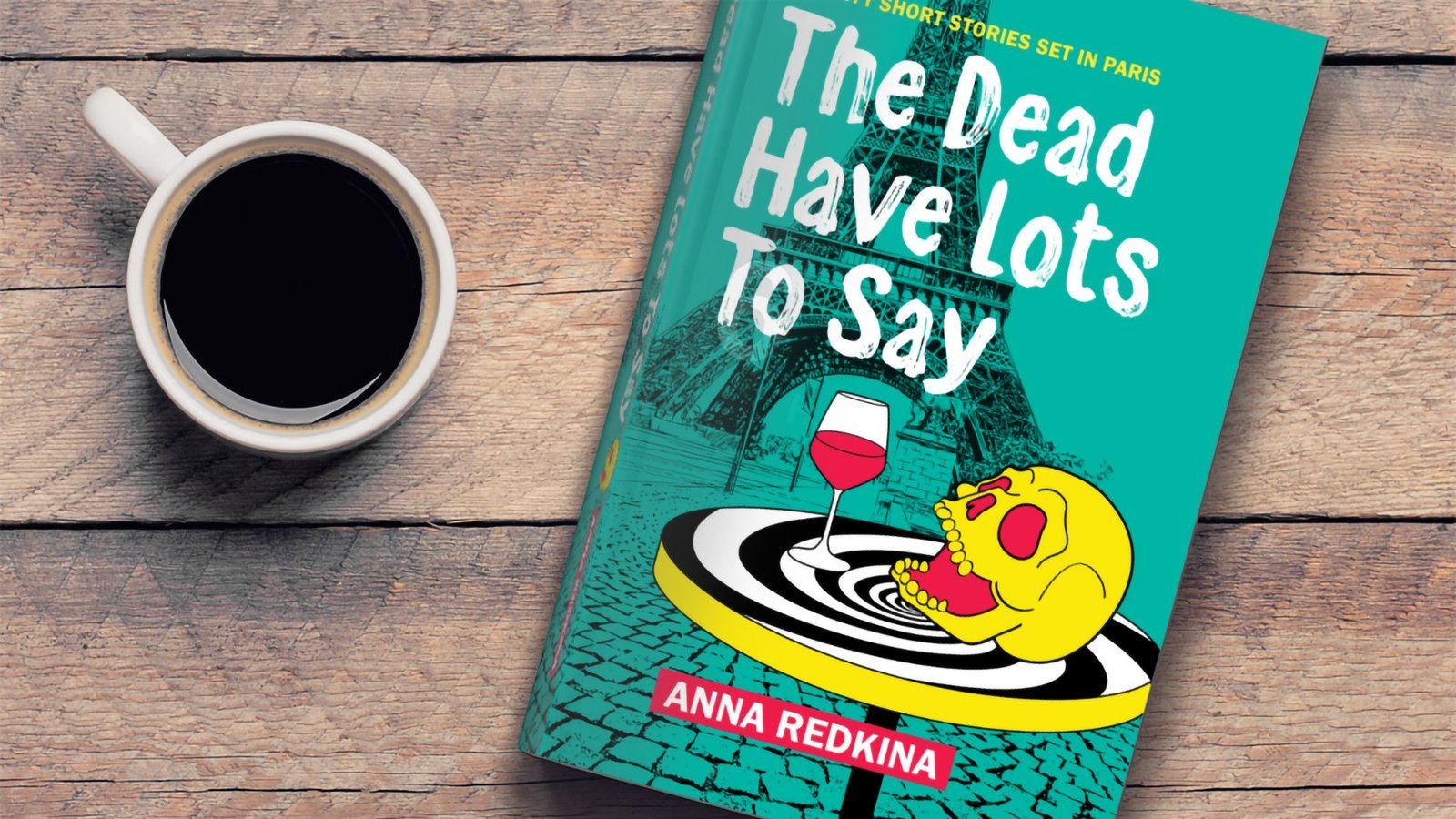
Twenty Short Stories Set in Paris
In Paris, a bunch of famous dead people from various eras come back to life to meddle with today’s Parisians.
Victor Hugo has a heated argument about love, Jim Morrison mocks a tattooed vegan, Marquis de Sade seeks punishment during social unrest, Charles Baudelaire stumbles across cute kittens on social media, Rimbaud and Verlaine fire guns in a bank, Marie-Antoinette’s head finds its happy place… and many more.
In this collection of twenty vignettes, one per Parisian arrondissement, a dreamlike, multifaceted world offers a hilarious study of humanity and once again proves that – without a doubt – the dead have lots to say.
For literary agents, publishers, press, or simply to say hello — drop me a line.
The worst thing was the walking stick.
The doctors said that it was temporary, that the thigh would get better with time, but Yvonne knew that at seventy-four time rarely sorted things out. Arthritis it was, merciless and ugly, like the walking stick itself. She tried not to make a big deal out of it and joked about always having a free seat on the bus now.
“This is nothing,” she kept telling her family and friends. “In fact, I can walk without it. This is just a backup.”
But it was always with her. It took her through Parisian streets, parks and gardens, museums and café terraces. It stayed near her bed, ready to help her get to the toilet, when her weakening bladder would wake her up in the middle of the night. It leaned on restaurant tables, and always got in the way when she wanted to grab a book from a shelf in her tiny Parisian flat.
On May 22, it faithfully led her to La Place des Vosges, Louis XIII Square — to the middle of it, to be exact — to her favourite bench, on the right from the main entrance. Yvonne loved sitting there, observing life unfold like a theatre play in front of her eyes, and no walking stick was going to change that.
“Out of sight, you, eye-sore!” Yvonne deftly hid the stick behind the bench.
The square was packed: families with children, youngsters with beers, boys with guitars, yogis, drunkards, readers, writers, dogs, cats, you name it. Just a few meters away a group of young girls were having a picnic on the lawn. They’d brought a red and white checked tablecloth and posh crystal glasses, which they kept filling with rosé champagne. The girls were giggling and chirping, feeding on big ripe strawberries as they drank. It had been unusually hot for the end of May, and they were wearing light summer dresses, blood red, sky blue, sun yellow. Stripes, dots and flowers showed firm breasts and strong thighs.
A soft voice distracted Yvonne. She turned her eyes from the girls and saw an old man standing near the bench and talking to himself.
“How come I never saw him approach?” Yvonne wondered. “As if he’d appeared out of thin air. I must be losing my hearing and eyesight too.”
She listened. The old man was reciting poetry and doing it louder and louder. He looked weird, too. He was wearing an old-fashioned dark-green velvet jacket even though the thermometer hit thirty that afternoon. Yet, it fit his wide shoulders perfectly well, which was so unusual for his age. He must have been at least eighty, Yvonne thought, but he looked after himself, or somebody else did. His white beard was neatly trimmed, and he smelled of fine perfume, too.
How come she was the only one to notice him? He should have attracted attention by now, reciting in full voice, one hand on his belly, and the other dancing in the air, following the rhyme of a poem about love:
“Aimons toujours ! Aimons encore ! …”
There was something touching about this old man. To encourage him somehow, Yvonne applauded:
“Bravo!”
He looked at her, surprised.
“Did you hear it?”
“Of course, I did. The whole square did, I think,” and Yvonne showed a dimple on her right cheek. She always did when she smiled.
“You think so?”
Not really. She seemed to be the only one who reacted to this old man. How strange, she thought. At the same time, people are so self-absorbed nowadays!
“It is not every day that you hear somebody recite Victor Hugo’s poems!” she winked.
“You recognized Victor Hugo’s poem? How do you know it was Hugo?”
“I used to be a teacher of French literature. It was part of the programme, of course, and one of my favourites.”
The old man looked satisfied.
“Would you mind if I sit down?” He pointed at the bench.
“Of course, I don’t mind; you have every right to sit on this bench. It’s a public place, hence I don’t own it. Fortunately, not everything is private in this country yet.”
“Victor.” the old man nodded, sitting down. “My name is Victor.”
“Nice to meet you, Victor. Yvonne.” She put her hand on her chest and slightly nodded too.
“So, what else did you teach, Yvonne?”
“Oh, plenty of wonderful authors! Balzac, Zola, Rimbaud…” she started to unfold her tiny fingers. “And then, more modern authors, for example…”
“Sorry,” Victor touched her elbow. His touch was soft and somehow pleasant. “I meant, what else by Victor Hugo?”
“Oh, the biggest one was Les Misérables, of course.”
“A real masterpiece, isn’t it?”
“Yes, a real bestseller too! An epic work, a work of genius, subtle, admirable … I just wish the author of this masterpiece hadn’t been such a piece of crap, as it turns out he had been.”
“What do you mean?”
“I read his biography a few months ago. A total disappointment, you know. I couldn’t even finish it, I was furious! His behaviour with women was disgusting!” She shook her head with disdain. “He was a hideous, horrible person.”
“Really? Wasn’t he the biggest romantic hero of all times?”
“No. A sexually obsessed, old paedophile!”
“A paedophile?”
“Seducing fourteen-year-old girls, how would you call it?”
“Many look and behave maturely enough at fourteen.”
“What difference does it make?”
“Maybe they wanted him to? He was so desirable, rich and famous. What obstacle could age be to love? Love is blind, don’t you think? So is passion.”
“Those ‘love’ experiences could be quite traumatising for a teenager.”
“I’d agree with that, love can be painful, but it can happen at any age. And suffering is part of it. We don’t live if we don’t suffer, and love suffering is so bittersweet…”
He sighed, observing the picnic girls in front of them.
“He didn’t seem to be the one who suffered, most of the time. He was quite amused, as some documents like The Black Book show it.”
“And what do you know about The Black Book?”
“As an old man, Victor Hugo wrote his sexual conquests there. He invented some kind of code. ‘Swiss’ meant he touched a maid’s breast, for example. Oh, he loved touching maids, just like some other hero of our times! Apparently, Hugo associated Switzerland with cows, cows with milk, and milk with female breasts, the old pervert.”
Victor seemed offended.
“On the contrary, a very clever code. Very creative.”
“And when he managed to have sex with those poor maids,” she continued without listening. “He’d write ‘todo’ in Spanish, which means ‘everything’. What a linguist, this Victor! What an inventive mind!”
Victor shrugged.
“Those word games were popular at his time. He proved himself very creative, that’s all. As for those women… Il y a des femmes qui prennent comme des allumettes…”
Yvonne sighed and shook her head.
“Anyway,” she continued after some silence. “I caught myself thinking that nowadays he’d never get away with what he did, like that Hollywood producer, remember? I mean, being so rich and famous, with such huge power… Remember Victor Hugo’s death? All France was following his coffin. He was known for his progressive views, he was everywhere, in politics, L’Académie française, and he sold millions of copies of his books. Yet, he harassed women. We don’t know if he literally raped his victims, although some of his biographies confirm it, and where to draw the line between ‘flirt’, ‘favour’ and ‘obligation…’ But he did use women to satisfy his sexual appetite, and he did use his power and notoriety for that. He was very insisting, to say the least!” She exclaimed, fidgeting with her fingers as she always did in anger.
Victor didn’t answer.
“Are you listening?”
He wasn’t. He was enthralled by the strawberry girls in front of them. They were tipsy now and paid little attention to if their dresses showed too much of a thigh or a breast.
“Excuse me.” Victor looked at Yvonne with a charming smile. “You know what it means to be old. You drift away sometimes. You were saying?”
You drifted away in a very certain direction, Yvonne thought. Another old pervert. Or, maybe, the same one? She looked attentively at his white beard, his old-fashioned jacket, and his small clever eyes.
“I was saying,” she pulled herself together, “That Victor Hugo wouldn’t get away with his behaviour with women nowadays, like all those Hollywood people.”
“Hollywood people?” Victor asked, but the corner of his eye went straight under one of the girls’ skirt.
“Take that Hollywood producer, for example. Remember, a few years ago? How did they call it in Facebook? Was it ‘Me also’? With a special typed sign in front? You see, like a square?” She drew a hashtag in the air. “You know, the campaign to denounce sexual harassment?”
Victor blinked.
“Sexual harassment. I guess it is easier for you to understand if I use Victor Hugo’s ‘creative’ code. It is when you do a ‘Swiss’ or a ‘Todo’ or you enter the maid’s ‘Cave’ without asking. Or touch her ‘Forest’ for 2 francs. You get it?”
He nodded.
“Of course, he was an ardent defender of women’s rights,” Yvonne continued. “But real life proved stronger. It always proves stronger, doesn’t it?” she observed Victor staring at the strawberry girls again.
“He was like most of them, Champagne socialists.” She sighed. “They talk about respect and equality, and then before you know it they are sticking their dick into a hotel maid.”
Victor blinked again.
“And the older he got the younger he liked them and more and more generous he became. Of course, all this money came from selling stories about poor Cosette…”
Yvonne’s fingers were still twitching, and the horizontal wrinkles on her forehead looked deeper. But Victor continued in his nonchalant manner:
“Yes, he liked them young and beautiful — like any man would — don’t you agree? He was not a second-hand bookseller when it came to love!” he chuckled, satisfied.
Yvonne stood up and took her stick from behind the bench.
“That’s exactly what he used to say. Not a second-hand bookseller.” And before Victor could say a word, she spiked her unsightly walking stick into his foot.
Why the hell did she want to meet here?
Thibault spotted an empty table on the terrace near the entrance and headed there. At least he could sit outside.
He looked at his mobile phone only to find out that he was well in advance and he was running out of battery. Shit! To make matters worse, he was in one of the most touristic places in Paris. What proper Parisian meets his girlfriend at a café at La Place du Tertre? God, what’s been wrong with her lately?
Now he has to wait on this lousy terrace drinking bad expensive beer and staring at mediocre artists and fussy tourists. Just look at their rucksacks with bottles of water sticking out of side pockets.
“What would you like, Sir?” He heard. “Would you like to have a look at our Happy Hour menu?”
“No, just a demi, please. Any lager.” Thibault breathed out without looking at the waiter.
“No problem, Sir. Thanks for your order, Sir.”
“The times have changed,” Thibault thought. “Now the waiters are polite even in the most touristic places, and I bet he speaks English all day long.”
“Please enjoy,” his beer was served in seconds.
“Thank you.” Thibault looked at the waiter.
A neat moustache was sitting on his full lips. His black beady eyes were smiling: “If you want something more sophisticated, please ask. I make incredible cocktails.”
I hope to get out of here before that, Thibault thought, but replied politely: “Thank you.”
He took his mobile out of his pocket and stared at the black dead screen for a second.
“She must be running late,” he heard the calm, beautiful waiter’s voice. “Just relax and enjoy this magnificent September evening. Could I possibly offer you another drink? A cocktail?”
“He’s right.” Thibault thought. “And it is The Happy Hour.”
“Ok. Surprise me then.” He said. “But nothing too strong, please, or too expensive.”
“You are in good hands.”
Thibault looked at the waiter’s hands. They were very big. In fact, his whole body lacked proportions a little.
“How much are Happy Hour cocktails?” He checked.
“5”
“5?”
“5. See, ridiculously cheap.” and he went inside.
Was he slightly limping?
“Today we start with A.M.B.A!” He reappeared and announced proudly, putting an elegant vintage glass in front of Thibault. It was decorated with a slice of lemon.
“My name is Henri,” he introduced himself, sitting down next to Thibault. “May I join you for a while?”
Something didn’t feel right. The terrace was full, but nobody seemed to care about Henri. As if he were to serve only Thibault. Also, his cocktail glass looked very different from other clients’. At the same time, most of them were drinking Coca Cola. Sad people. Thibault took a sip of his gorgeously presented cocktail. My, oh my, that was strong!
“Good? Do you like it?” Henri crossed his fingers.
“Strong.” Thibault took a deep breath and a deep sip. “What’s inside?”
“I am not going to give away all my secrets, am I?” Henri winked. “Let’s say that there is a bit of Scotch. Also, some Rum, some Vermouth, the red one, you know. And maybe some Cointreau… Oh! I finally gave away all my secrets, didn’t I?” He laughed. “And you haven’t introduced yourself.”
“Thibault.”
“Do you come here often, Thibault?”
“Oh no, of course not! I live in Paris”
“Why don’t you like it here?”
“Too touristy. I am not against tourists. I just don’t like mass tourism.”
He took another sip and moved closer to Henri.
“Look there. Do you see those?” He pointed at a group of tourists, mostly women.
“U-hum.”
“You can say straightaway that they are American.”
“Really? How?”
“They are extremely loud and they wear their typical shorts showing their ugly fat legs.”
“Should they cover their ugly fat legs?”
“No, I didn’t say that. But you can immediately see that they are not locals.”
“You mean the French don’t wear shorts?” And he quickly glanced at Thibault’s checked Bermuda.
“Not this kind of shorts, no.”
Thibault finished his drink and fretted:
“Do you know what time it is? My girlfriend should have been here by now.”
Henri looked at his watch.
“Ten to seven.”
“Twenty minutes late. This is so unlike her.” He sighed and double-checked his mobile. It was dead.
“An excellent reason to have another cocktail, don’t you think?” Henri clicked his fingers and ran inside only to reappear in a few minutes holding an intricate glass.
“Et voilà ! Saratoga!”
Thibault observed his new friend for a few seconds.
“How come he is so short all of a sudden?” He looks like a dwarf. Has he shrunk?”
Then he looked at the promising Saratoga.
“Okey. Okeeey.” Henri was singing. “I’ll tell you. Angustura, first of all. A few drops. I won’t tell you exactly, to keep some of my secrets at least! Cognac liquor. Whiskey liquor. Noilly liquor.”
Thibault desperately looked at his glass.
“All in a Bordeaux wine glass!” Henri added proudly. “Just try it! It is divine.”
Thibault took a sip and nodded, gasping for some air.
“So, going back to the shorts,” Henri said. “Do you mean that they have to wear the same shorts as French women do?”
“How can I explain … Look, here is an example. When I travel, I try to live and look like a local. Last year when I went to Sri-Lanka, I bought local clothes. They are completely unlike anything we wear here in Europe. You know, men wear long dresses there, called sarongs. So, I bought one and was wearing it while I was travelling there.”
“But you have blond hair.”
“So what?”
“It is obvious that you are European.”
“It doesn’t matter. The locals see that I am making an effort to respect their culture.”
“By wearing their traditional clothes?”
“Among other things. I eat like locals. I get up and go to bed like locals.”
“U-hum.”
“There is nothing worse when people travel and try to bring their culture with them.”
“I still don’t understand the connection with shorts…”
“Well, they would be more welcome if their clothes were more like French ones.”
“Like, a beret and a striped shirt?”
“Henri, don’t be silly! Not a beret, of course. This is a cliché. I am talking about normal clothes that correspond to proportions. Look at their big asses.”
“So, it’s about them being fat?”
“It’s about them being Americans wherever they go. With their shorts and their Coke.”
“But we are not going to drink Coke, are we? We will stick to another great American invention: Cocktails!” Henri winked. “It is high time for my Signature cocktail, my friend!”
“Could you bring me some water first?” Thibault begged.
“Why would you want water?”
“To survive your Cocktails.”
“There is no way of surviving them, my friend.”
“As long as there are no fizzy chemicals in them.” Thibault shrugged.
Henri solemnly stood up. Another glass appeared in his hand, as if he were a magician.
“Dear Sir! Let me present you my Signature cocktail. Earthquake.” He took off his hat and bowed.
Did he have a hat before?
Thibault bowed too.
What an amazing evening, he thought. Sometimes it is nice to improvise. Hopefully she is fine. It doesn’t matter. What could have happened? Nothing. Nothing ever happens. I’ll call her tomorrow. We always depend on technology nowadays. We used to survive without mobile phones. We used to meet in bars, in this country at least. Make new friends. So… fuck it.
“Are you still thinking about those American tourist asses?” Henri asked.
“Fuck it!” Thibault insisted loudly.
“Absolutely! Fuck it!”
“You know what, Henri. Thinking about it… They can wear whatever they fucking want. We are in a free world, although here it is a question of respect, not freedom, you know. But. But!” He raised his eyebrows. “But in this case they shouldn’t be surprised that people see them as bloody tourists, don’t like them or simply stare at them.”
“Fair.” Henri nodded, giving Thibault his cocktail.
“You call this Earthquake?” Thibault smelled the glass. Notes of Cognac? Brandy? No, Cognac. Pastis? Something with anisette. Strange colour, too.
“Your cocktail looks dodgy, Henri.” He concluded. “But I will drink it, my friend.”
“With great pleasure!” and he sent the whole of Henri’s Signature directly into his stomach.
***
That was the last thing Thibault remembered.
He opened his eyes. It was morning.
He was in his room and in his bed.
Good.
Alone.
Good.
He was lying in his bed, under the covers, like a civilized human being.
Good.
He tried to get up, and groaned. A thousand hammers in his head started their sadistic concert.
His whole body was aching, too. Even his nails hurt.
“Courage!” He convinced himself and finally got up.
“I ran out of battery last night,” Thibault remembered. “I need to check my messages.”
He looked under the bed, and saw his phone.
Good.
There was something else there though, like a paper bag.
Thibault dragged the phone and the bag from under the bed.
“What is this?” He carefully examined the bag and pulled out a rolled art print.
“Did I buy it last night? I don’t remember buying anything…” Thibault turned pale. “God, I didn’t buy some art from La Place du Tertre, did I?”
“Courage!” He said to himself, and uncurled the print.
He studied it for a while, and then looked at the inscription at the bottom of it.
“You bastard! You are a grotesque genius little bastard, Henri.”
And then he read the inscription again, out loud:
A Parisian looking at three fat American asses, by Henri de Toulouse-Lautrec.
KRISTINA — Cleaner, illegal immigrant from Eastern Europe
PAULIE — Artist
REBECCA — Entrepreneur and mother of two
SOPHIE — In her eleventh year of a PHD in Sociology, living off the state
VINCENT — Journalist
VINCENT: Thank you for coming.
REBECCA: Thank you for inviting us.
PAULIE: You are welcome.
KRISTINA: (with an accent) You are welcome.
SOPHIE: Yeah. I hope this won’t take long.
VINCENT: As you know, you are the four main witnesses of an extraordinary event that happened on April the 12th. I invited you here to put together your stories to write The story about Josephine Baker’s recent appearance in Paris, for the newspaper which is…
PAULIE: Sorry, Vincent, just one detail: that woman looked like Josephine Baker. Josephine Baker died a long, long time ago. When was it that she danced in her banana skirt? In the 20s? The 30s?
SOPHIE: She died in the seventies. There is much more to Josephine Baker than a banana skirt.
PAULIE: (Makes a zombie face) Ok, but she is really dead.
REBECCA: That woman looked exactly like Josephine Baker, though. I googled the pictures afterwards.
KRISTINA: Who is Josephine Bakery?
SOPHIE: The woman you saw near the Pitié Salpêtrière Hospital with a bunch of kids. It actually makes sense as she died in that hospital.
KRISTINA: The Negro woman?
REBECCA: (makes a choking sound) How can you use this word?
SOPHIE: Can we start, please? I don’t have much time; I have to hand in a new chapter of my thesis by Friday.
VINCENT: (cheerfully) Let us start from the beginning, then! How exactly did she appear? Who would like to start?
SOPHIE: I will. I was walking past the hospital and I saw her. There she was, with her twelve kids. I didn’t see any magical appearance, but the resemblance was striking.
VINCENT: Twelve kids? Did you count them?
SOPHIE: No, but she had adopted twelve kids and all of them seemed to be there.
PAULIE: Josephine Baker adopted twelve kids?
SOPHIE: Yes, when she stopped dancing in a banana skirt.
REBECCA: She then worked for the French resistance, during the war. She was a spy. She pinned notes into her undergarments knowing that no one would strip-search her as a celebrity. A truly remarkable woman. I googled it afterwards.
SOPHIE: And then she decided to show the world that people of any race and religion can live in peace. This is when she started to collect children. She went around the world to pick them: Japan, Algeria, Venezuela… And then she put them in one big house and exhibited them as her fighting-the-racism achievement.
VINCENT: So, you recognized the children and Josephine Baker?
SOPHIE: I didn’t say that. I only said that the resemblance was striking.
REBECCA: (quietly) Because it was her.
VINCENT: Could you describe her? What was she wearing? What about the kids? What did they look like? How did they behave?
SOPHIE: She was wearing a long white dress and a hat with a huge feather, and…
REBECCA: Several feathers.
SOPHIE: I only remember one big feather. The kids looked bored.
REBECCA: Nonsense. They looked happy because they were going to the Zoo.
PAULIE: How the hell can you know that?
REBECCA: Jardin des Plantes Zoo is just around the corner. Where else would you take twelve kids?
PAULIE: If you say so.
SOPHIE: Actually, this could make sense, as the only place she ever took her poor kids was the zoo. I mean, when she was not exhibiting her “Rainbow Tribe” as she called them in her own Disney Land, for photos or advertising.
VINCENT: Please, let us put our judgments aside and move on with the story. Rebecca, you had mentioned a camera?
REBECCA: Yes, I was taking my kids to the nursery, but then I saw this amazing woman who looked familiar, so I couldn’t help coming closer. She saw me, took a camera from her bag, and asked me to take a picture of her and her kids…
PAULIE: Yes, I was sitting in a café nearby, having a nice glass of Bourgogne Aligoté, and I saw her (pointing at Rebecca) take the picture. Actually, it was quite an interesting scene to watch. The woman who looked like Josephine Baker said: “Come on kids, come closer, show how much you love your mommy!” but the kids didn’t seem very obedient. Two of them started to fight. “Brahim, sale Arabe !” I heard. It was one of the white boys.
REBECCA: This never happened! They happily posed for the photo with their mom. It was obvious how much they loved her and were grateful to her, poor creatures.
SOPHIE: Grateful for what exactly?
REBECCA: For adopting them, saving them from misery, and showing the world that people of different races and religions can live together in peace.
PAULIE: Yes, like that boy said: Brahim, let’s live in peace.
REBECCA: For god’s sake, he never said that. Vincent, who would you believe: a rough guy in his 40s who drinks his chilled Bourgogne Aligoté in the morning, or myself who was actually taking the picture?
VINCENT: Well, it is…
PAULIE: It was not chilled. You never drink Bourgogne Aligoté chilled.
SOPHIE: Bourgogne Aligoté?
VINCENT: It is very good with fish, chilled or not.
(Everybody becomes silent)
KRISTINA: (suddenly) He say this. Sale Arab. I hear.
VINCENT: (enthusiastically) Yes, Kristina, please, let us listen to your story.
KRISTINA: I hear this when Madame take photo. Children very different. Arab, Negros, and Chinese (pulls her eyes with her fingers to make them look Asian)
REBECCA: (stands up) My goodness!
KRISTINA: What? I nothing against, they look so.
PAULIE: (Takes out a notebook and starts drawing) This is so much fun!
KRISTINA: Why this woman have all children? Not her children.
SOPHIE: To flatter her ego, mostly. She also set a trend. You know, now celebrities go to Africa to adopt babies.
PAULIE: (quietly) I don’t understand the idea of adoption as such. Kids are like farts: you can only love your own.
REBECCA: (to Sophie) How can you bitch this incredible woman after what she did for this country and the world?
VINCENT: Please, let us go back to the story.
REBECCA: No, Vincent, let this pseudo intellectual answer.
SOPHIE: As Simone de Beauvoir said: “Being an intellectual is…”
(PAULIE diabolically laughs. KRISTINA yawns)
REBECCA: You didn’t answer my question.
SOPHIE: Have you looked at it from the kid’s perspective? Being a tool for their mother’s ego to prove something to the world? Those kids were unhappy and poorly looked after, didn’t you google it afterwards?
(REBECCA shakes his head in disbelief)
VINCENT: Please, ladies, let us go back to the story.
PAULIE: Ladies and a gentleman.
VINCENT: (apologetically) Of course.
PAULIE: After Rebecca had taken the picture, the woman who looked like Josephine Baker put her camera away and started moving towards… ok, let it be Jardin des Plantes.
REBECCA: She gave me her autograph, and then headed to Jardin des Plantes.
PAULIE: I didn’t see that.
SOPHIE: Then she suddenly stopped, looking at something. I looked in that direction.
VINCENT: Where was she looking?
PAULIE: There was a homeless woman, probably a refugee. She had four little kids with her.
SOPHIE: Five.
KRISTINA: Three.
REBECCA: All the children were crying.
SOPHIE: Not all of them. The baby was crying, but they always do, don’t they? Others were playing.
REBECCA: The baby was cold and hungry, only a blind person couldn’t notice that. Josephine couldn’t just stand and look at this misery, so she came up to the homeless woman and asked her how she could help.
PAULIE: By that point I had finished my Bourgogne Aligoté, and came closer as I thought I could draw the scene. Josephine Baker-looking woman was talking to the refugee. She asked her if she could help her and her children, but I think the refugee didn’t speak any French.
REBECCA: She spoke some French. She said: “Je ne comprends pas”, “Madame”, and something else.
PAULIE: “Josephine” was trying to explain that she would like to take care of her baby, either as a God Mother or a Second Mother. She kept saying: the baby will have two mothers now…
REBECCA: Isn’t it beautiful? She was doing what was the best for the poor baby…
PAULIE: (Makes a ghost face) Her Rainbow Tribe would be 13 now… Spooky!
SOPHIE: But the poor woman could not understand Josephine and (imitates Rebecca) “what was the best for her poor baby”. So, Josephine started to use gestures and mime to explain herself. She reached out and took the baby from her arms.
REBECCA: She didn’t. She only pointed at the baby.
SOPHIE: She bloody did. Why else would the poor refugee start screaming?
REBECCA: But Josephine’s intentions were good.
SOPHIE: I never said the contrary. It always starts with good intentions.
PAULIE: That was quite a scene. I drew it.
(Shows a drawing of two angry women and children around them)
SOPHIE: It was complete chaos: the homeless woman screaming, children crying, running everywhere, until somebody called the police.
VINCENT: Who called the police?
SOPHIE: I don’t know. It was somebody from the neighbourhood, perhaps.
REBECCA: That was ridiculous as Josephine gave the baby back to the woman, kissed her, gave her some money and managed to explain that she would take them all to the zoo. But the Police arrived too fast…
SOPHIE: Josephine finally let the baby go and called the mother Imbecile.
PAULIE: She never insulted the refugee. She just angrily gave the baby back, and walked away. They didn’t walk away together.
REBECCA: They did!
SOPHIE: In any case, the Police arrived.
KRISTINA: When I hear word police, I run away. But homeless woman happy with her baby and understand nothing.
REBECCA: The police took them both to the station.
SOPHIE: No, they didn’t even pay attention to Josephine, and only took the refugee and her children.
PAULIE: The woman who looked like Josephine tried to negotiate with the police, saying that it was all her fault, but they didn’t listen. Then she just disappeared into thin air with all her kids.
SOPHIE: I am sure the refugee is already on her way to her country facing war and misery again.
VINCENT: The police say that they never saw anybody like Josephine Baker when they arrived. And they would have remembered twelve children of different backgrounds.
KRISTINA: (scoffs) I believe my eyes!
REBECCA: I saw what I saw. The police are lying.
SOPHIE: Of course they are.
PAULIE: (finishing his drawing) Without a doubt.
I’m delighted to announce that the French translation of The Dead Have Lots To Say is now available, published under the title Les morts ne manquent pas de conversation.
Celebrating World Book Day at the EOI Cádiz — talking about Paris, literature, and the stories behind The Dead Have Lots To Say.
A wonderful evening at Castelló de la Plana — an engaged audience, great questions, and lots of conversations about Paris, history, and short fiction.
A full house in Bilbao for the presentation of The Dead Have Lots To Say — both the English and French editions on the table, and a lively discussion about Parisian ghosts crashing into modern life.
Sant Jordi in Xàtiva, Valencia — the perfect occasion to share books, roses, and stories. A joyful afternoon with readers in the community.
After the book presentation in Gandia on World Book Day — a sunny afternoon with enthusiastic readers holding copies of The Dead Have Lots To Say and Les morts ne manquent pas de conversation.